
Chores for 4 Year Olds
Good chores for 4-year-olds include putting toys in a bin, placing clothes in a hamper, matching socks, setting out napkins, and helping clear unbreakable dishes. Teach each task first, stay nearby, and offer help. Your child is learning how to contribute; they do not need to finish every job independently.
Start with one small job your child can manage. Below, you will find a practical chore list, supervision tips, a sample routine, and free picture chore charts to help you get started.
Go to the free picture chore charts
What Can a 4-Year-Old Realistically Do?
At four, many children enjoy being helpers, but enthusiasm, coordination, attention, and confidence vary. The CDC’s four-year milestones include liking to help and serving food or pouring water with adult supervision. These are useful starting points, not a requirement to complete a particular chore list.
Choose tasks that fit your child’s abilities and your home. A child who can put three toy cars in a basket may still need an adult alongside them to tidy a play area. Reminders and shared work are normal.
The American Academy of Child and Adolescent Psychiatry (AACAP) suggests helping feed pets, making a bed imperfectly, and helping clear the table for ages four to five. Chores offer practice in responsibility and everyday skills; they do not guarantee later academic or relationship success.
Chore List for 4 Year Olds
This is a menu of ideas, not a daily checklist. Pick one or two to try. “After teaching” means the task may eventually need only a reminder, with an adult nearby. “Do together” means active adult help or close supervision throughout.
| Chore | Make the job specific | Adult’s role |
|---|---|---|
| Put toys away | Put the blocks in one labeled bin. | After teaching: point to the bin and give one category at a time. |
| Put books away | Return a few books to a low shelf. | After teaching: use a reachable shelf on secured furniture. |
| Put clothes in the hamper | Put today’s pajamas in the basket. | After teaching: keep a light basket within reach. |
| Put shoes away | Place both shoes in the shoe basket. | After teaching: give shoes a clear home. |
| Help make the bed | Straighten a pillow and pull up a light blanket. | Do together: help with awkward bedding; skip heavy lifting. |
| Match socks | Find pairs in a small pile of clean socks. | After teaching: start with a few easy-to-match pairs. |
| Sort laundry | Put washcloths in one pile and socks in another. | Do together: handle laundry products and appliances yourself. |
| Fold washcloths | Fold each small cloth in half. | After teaching: accept uneven folds. |
| Set out napkins | Put one napkin at each place. | After teaching: keep supplies reachable; adults carry hot or breakable items. |
| Clear their place | Carry an empty unbreakable cup to a low collection spot. | Do together: check for heat, sharp items, and a clear walking route. |
| Wipe a small spill | Wipe spilled water with a cloth. | Do together: adults handle hot, greasy, chemical, or broken-glass spills. |
| Dust a clear surface | Wipe an empty low shelf with a dry cloth. | Do together: remove fragile items; do not give cleaning sprays. |
| Put away light groceries | Put a box of cereal on a low pantry shelf. | Do together: select safe items; adults handle cans, glass, and heavy bags. |
| Water a plant | Pour a small, premeasured cup onto the soil. | Do together: choose a safe, reachable plant; keep fertilizers out of reach. |
| Help feed a pet | Help measure food while an adult manages the animal. | Do together: avoid pets that guard food; wash hands afterward. Adults remain responsible for pet care. |
| Collect paper scraps | Put clean craft-paper offcuts in a bin. | After teaching: adults inspect first; no mixed trash, staples, or sharp objects. |
For other ages, see our age-appropriate chores guide. Age ranges are suggestions; adapt the task to the individual child.
Personal-Care Tasks to Practice Alongside Chores
Getting dressed and caring for personal belongings are daily routines rather than shared household jobs. You can include them on a routine chart if that helps your family:
- Choose between two weather-appropriate outfits and get dressed with help.
- Put on easy-fastening shoes; ask for help with laces or difficult fasteners.
- Put a preschool bag in its usual spot and add an adult-selected item. An adult checks the contents.
- Wash and dry hands with guidance.
- Take a turn brushing teeth, followed by an adult brushing thoroughly. At four, watching alone is not enough: the American Academy of Pediatrics’ toothbrushing guidance says children usually need hands-on help until around age eight.
Safety: Jobs to Keep With Adults
Check the space and materials before each new chore. Being able to reach something does not make it safe to use.
- Cleaning products and medicines: adults handle sprays, disinfectants, bleach, detergents, and laundry or dishwasher pods.
- Laundry machines: let your child sort clothes in a basket away from the machines. Adults operate washers and dryers; children must never climb into them or reach inside.
- Dishwashers: use a low collection spot for the child’s cup or plate instead. Adults manage sharp utensils, glass, detergent, hot dishes, and the machine.
- Kitchen hazards: adults handle knives, hot food and liquids, stovetops, and electrical appliances. Keep children’s jobs away from cooking areas.
- Climbing, lifting, and outdoor risks: avoid tasks requiring climbing on furniture, heavy loads, traffic exposure, or unsupervised access to water.
- Other children and animals: never make a four-year-old responsible for supervising a sibling or walking a dog alone.
How Many Chores Should a 4-Year-Old Have?
There is no universal number. A practical starting point is one or two tiny, familiar jobs a day, each taking only a few minutes. This is a suggested starting routine, not a developmental standard. Begin with less if needed and add a task only when the current routine feels manageable.
For example, start with pajamas in the hamper each morning. Once that feels familiar, try putting blocks away together after play. Leave plenty of time for play and rest.
A Simple Daily Routine to Try
| When | Child’s small job | Helpful adult prompt |
|---|---|---|
| After getting dressed | Put pajamas in the hamper. | “Where do your pajamas go?” |
| After play | Put blocks in their bin together. | “I’ll pick up the big blocks; you find the little ones.” |
| Before dinner, occasionally | Set out napkins with you. | “Let’s give each person one napkin.” |
How to Teach a Chore Without Repeated Nagging
- Prepare the space. Put the basket or supplies where your child can safely reach them.
- Show one small action. Demonstrate putting a toy car in its bin.
- Try it together. Invite your child to put the next car away while you stay beside them.
- Describe the finish. “The cars go in this basket” is clearer than “Clean your room.”
- Notice the contribution. “You put the cars away, so we have room to play” tells your child what helped.
The AAP’s guide to chores and responsibility emphasizes realistic expectations, routines, and encouragement. Accept a useful effort even if the result is uneven. If something needs finishing for safety or hygiene, help your child complete it without treating the attempt as a failure.
What If My Child Refuses or Gets Distracted?
First check whether the job is unclear, too large, or badly timed. A tired child after preschool may need a break before helping.
- Offer two manageable choices: “Would you like to put away the books or the cars?”
- Shrink the task: “Put these three cars away” instead of “Tidy everything.”
- Make starting easier: stay alongside them, take turns, or use a short cleanup song.
- Keep the reminder concrete: point to a photo of the finished shelf or the correct basket.
If your child has sensory, communication, attention, or mobility needs, change the tools, steps, or level of help. A seated sorting task, a larger handle, or one item at a time may be a better fit. Supported participation counts. If you are concerned about lost skills or wider developmental difficulties, discuss them with your child’s pediatrician.
Free Picture Chore Chart for a 4-Year-Old
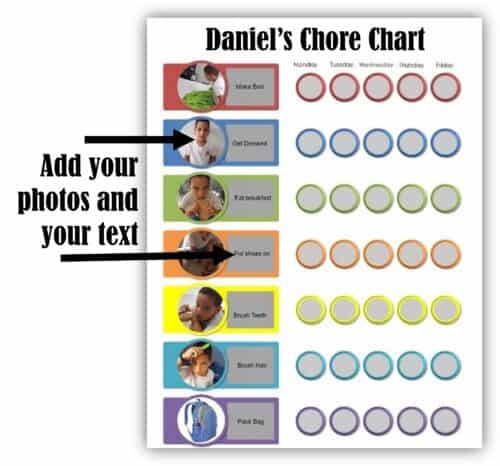
Many four-year-olds are not yet reading independently, so a picture can make a task easier to recognize. Our free chore chart templates include options for adding your own photos or pictures.
Set Up a Chart Your Child Can Use
- Choose one or two tasks. Use specific labels such as “Toys in bin” and “Pajamas in hamper.”
- Add a matching picture. A photo of your child’s actual toy bin can be easier to understand than a general picture of a tidy room.
- Explain what counts. For a new task, doing the agreed step with your help counts as completion.
- Mark it together right away. Let your child add a sticker or check mark after helping.
- Review after a week. Keep tasks that work; simplify or replace ones that repeatedly cause frustration.
Example chart labels: “Clothes in hamper,” “Books on shelf,” “Napkins on table.” Avoid vague targets such as “Be good” or “Don’t be lazy.”
Frequently Asked Questions
Should I Pay My 4-Year-Old for Chores?
You do not need to pay for everyday helping. You can introduce small family contributions as something everyone practices. If your family chooses pocket money or rewards, keep the arrangement simple and explain it beforehand.
Are Sticker Charts Helpful at This Age?
They can provide a visible reminder and a way to celebrate practice. Keep the goal small and give encouragement as well as a sticker. If you use a reward, choose something simple, such as choosing a family game, and explain when it is earned. Avoid making the chart a competition between siblings.
Can a 4-Year-Old Make Their Own Bed?
They can often help by straightening a pillow or pulling up a light blanket. An adult may need to help with sheets and positioning. A bed that looks a little rumpled can still represent a completed practice task.
What Are the Easiest Chores to Start With?
Try putting pajamas in a nearby hamper, placing shoes in a basket, or putting a few familiar toys in one bin. Choose a task with a clear destination and an obvious finish.
Should Chores Be Different for Boys and Girls?
Offer the same range of tasks to every child. Choose by safety, ability, interests, and support needs.
Sources and Further Reading
The developmental guidance above draws on the following sources. The sample routines and chart labels are practical examples to adapt to your family.