

Growth Mindset for Kids: How to Help Kids Believe They Can Learn and Improve
As parents and educators, we often praise children for being “smart” or “talented.” But what happens when they face a challenge that talent alone can’t solve? They often give up.
The secret to raising resilient, confident children isn’t just about what they know—it’s about how they think. This is where growth mindset for kids comes in. It is one of the most powerful tools you can give a child to help them navigate school, hobbies, and life’s inevitable bumps. When kids believe they can get better with effort and practice, they are more willing to try new things, make mistakes, and keep going even when something feels hard.
This guide explains what a growth mindset is in a kid-friendly way, compares it to a fixed mindset, and shares practical activities, free posters, affirmations, and quotes you can use to help kids build this mindset in everyday life.
Free Growth Mindset Posters

What Is a Growth Mindset for Kids?
A growth mindset for kids means believing that abilities can grow with effort, practice, and learning.
Kids with a growth mindset understand that:
- They don’t have to be good at something right away
- Mistakes are part of learning
- Trying again can lead to improvement
- Asking for help is okay
Instead of thinking, “I’m just bad at this,” a child with a growth mindset learns to say, “I’m not good at this yet.”
That small word — yet — makes a big difference.
Growth Mindset Definition for Kids
Before we can teach it, we need to understand it. The term was coined by psychologist Carol Dweck, but the growth mindset definition for kids is actually quite simple:
It is the belief that intelligence and abilities can be developed through hard work, good strategies, and input from others.
When answering the question, “what is growth mindset for kids?” it’s helpful to use the “Brain Muscle” analogy. Explain to your child that their brain is just like a muscle.
A simple growth mindset definition for kids is:
“Your brain is like a muscle. The more you use it, the stronger it gets. When you lift heavy weights (do hard math problems or practice a difficult song), your brain “muscles” get stronger. If you only do easy things, your brain doesn’t grow.”
A growth mindset means believing your brain can grow and get stronger when you practice, try hard, and learn from mistakes.
This idea helps kids understand that learning isn’t about being “smart” or “not smart” — it’s about effort, practice, and persistence.
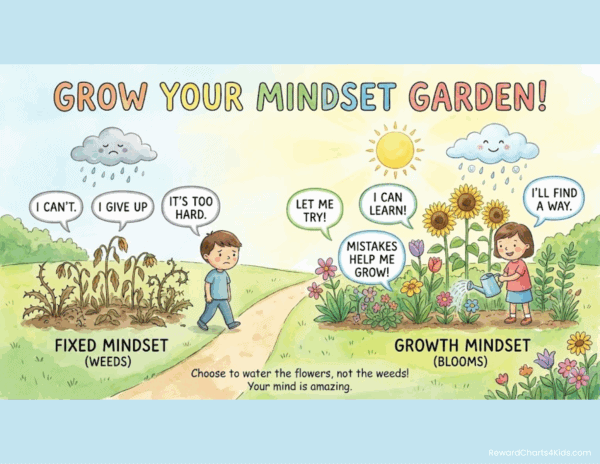
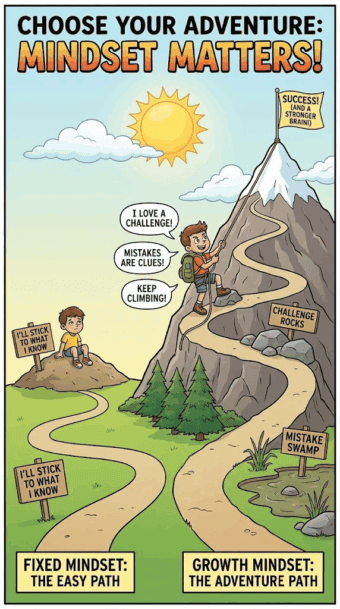
Growth Mindset vs Fixed Mindset for Kids
Understanding the difference between a growth mindset and a fixed mindset helps kids recognize their thoughts and shift them in a healthier direction.
Fixed Mindset (for kids)
- “I can’t do this.”
- “I’m not smart.”
- “I always mess up.”
- “I’m just bad at math/reading/sports.”
A fixed mindset makes kids feel stuck and discouraged, especially when something feels difficult.
Growth Mindset (for kids)
- “I can learn how to do this.”
- “I’ll get better with practice.”
- “Mistakes help me learn.”
- “This is hard, but I’ll keep trying.”
A growth mindset helps kids feel capable, motivated, and open to learning — even when things don’t go perfectly.
Why a Growth Mindset Is Important for Kids
A growth mindset helps kids:
- Build confidence without pressure to be perfect
- Handle mistakes without giving up
- Develop resilience when facing challenges
- Enjoy learning instead of fearing failure
- Try new things more often
Kids with a growth mindset don’t avoid challenges — they learn how to work through them.
Growth Mindset Activities for Kids
You can’t just tell a child to change their mindset; you have to practice it. Hands-on activities are one of the best ways to help kids understand and practice a growth mindset.
Here are 5 effective growth mindset activities for kids to try at home or in the classroom:
1. “Yet” Statements
Take fixed mindset statements and add the word yet.
- “I can’t read this” → “I can’t read this yet.”
- “I don’t know how” → “I don’t know how yet.”
2. Mistake of the Day
Have kids share one mistake they made and what they learned from it.
This helps normalize mistakes and removes fear around them.
3. Famous Failures
Research famous people who failed before they succeeded (e.g., Michael Jordan being cut from his high school team, or Walt Disney being fired for lacking imagination). Discussing these stories normalizes struggle.
4. Effort Praise
Instead of praising results, praise effort:
- “You worked really hard on that.”
- “I like how you didn’t give up.”
- “You tried a new strategy.”
5. Brain Growth Talk
Explain how learning creates new connections in the brain.
You can say:
“Every time you practice, your brain grows stronger.”
Empowering Growth Mindset Affirmations for Kids
Self-talk is a huge part of mindset. If a child constantly hears negative thoughts, they start to believe them. Replace that inner critic with growth mindset affirmations for kids.
Growth mindset affirmations for kids help build positive self-talk and confidence.
Encourage your child to choose one of these to say every morning:
- Challenges make my brain stronger.
- I can do hard things.
- My mistakes help me learn.
- I am in charge of how much I learn today.
- I can learn new things.
- Mistakes help me grow.
- I get better when I practice.
- I can try again.
- Hard things help my brain grow.
- I don’t have to be perfect.
Saying affirmations daily helps kids replace negative thoughts with encouraging ones.
Inspiring Growth Mindset Quotes for Kids
Short, simple quotes can reinforce growth mindset ideas in a memorable way. Hanging up posters or notes with growth mindset quotes for kids can serve as great visual reminders.
Examples of growth mindset quotes for kids:
- “It’s not that I’m so smart, it’s just that I stay with problems longer.” – Albert Einstein
- “I have not failed. I’ve just found 10,000 ways that won’t work.” – Thomas Edison
- “Mistakes are proof that you are trying.”
- “Mistakes are proof that you are trying.”
- “I can learn anything if I practice.”
- “Hard work helps me grow.”
- “I am learning every day.”
- “Trying is more important than winning.”
Quotes work well on posters, worksheets, morning routines, or classroom walls.
Growth Mindset Worksheets for Kids
Growth mindset worksheets for kids give structure to reflection and practice.
Popular worksheet ideas include:
- Sorting fixed mindset vs growth mindset statements
- Writing how to turn negative thoughts into positive ones
- Reflecting on challenges and what was learned
- Drawing or coloring growth mindset messages
Worksheets are especially helpful because they:
- Encourage self-reflection
- Make abstract ideas concrete
- Help kids slow down and think
They also work well at home, in classrooms, or during counseling sessions.
Final Thoughts
Teaching a growth mindset to kids isn’t about pushing them to try harder all the time — it’s about helping them believe they can grow, even when something feels difficult.
With the right language, activities, worksheets, affirmations, and encouragement, kids learn that challenges are not something to fear — they are opportunities to learn.